A platform approach for the purification of antibody fragments (Fabs)
Posted on November 3, 2014
This Application note describes a three-step purification process of a Fab originating from an E. coli supernatant. First, chromatography media (resins) were screened in 96-well PreDictor™ plates, using wide wash and elution conditions. Next, capacity studies were performed in small columns with purified protein, and elution studies in columns were performed to find the optimal elution pH. Design of Experiments (DoE) was used to further optimize the conditions for each step. This general approach supports Quality by Design (QbD), where the plates give the characterized space and the DoE in columns render both the design and the control space. Using Capto™ L, Capto SP ImpRes, and Capto Q media in the three step process resulted in efficient removal of the main contaminants and high yields (≥ 87%) over the entire process. This platform approach enables increased efficiency and productivity in developing therapeutics based on antibody fragments.
Antibody fragments (e.g., Fab, scFv, domain antibodies, etc.) are set to become the next important class of proteinbased biotherapeutics after monoclonal antibodies (MAbs). One of the advantages is that due to their structure and smaller size, antibody fragments possess properties (e.g., easier tissue penetration) that suit a range of diagnostic and therapeutic applications.

The industry standard for purifying MAbs is a platform approach using affinity chromatography with protein A as the capture step. The high purification factor and generic conditions associated with this approach have proven particularly attractive to biopharmaceutical manufacturers. Antibody fragments, however, have previously lacked such a platform solution. With the introduction of Capto L, the first industrial platform for the purification of antibody fragments is now emerging. With its recombinant protein L ligand, Capto L is a BioProcess™ chromatography medium with a broad range affinity for antibody fragments of different sizes containing kappa light chains (Fig 1).
A three-step Fab purification process using Capto media Here we describe an example of using Capto media in a purification process of a kappa subclass Fab originating from an E. coli supernatant. Table 1 shows the properties of the Fab.

During the set-up of this three-step process, a general workflow was used with the purpose of minimizing the development time by using High Throughput Process
Development (HTPD) tools:
1. Choose media and wash or elution conditions by screening in plates
2. Perform capacity studies (column) with purified protein (only binding steps)
3. Make elution study in columns
4. Perform DoE in columns
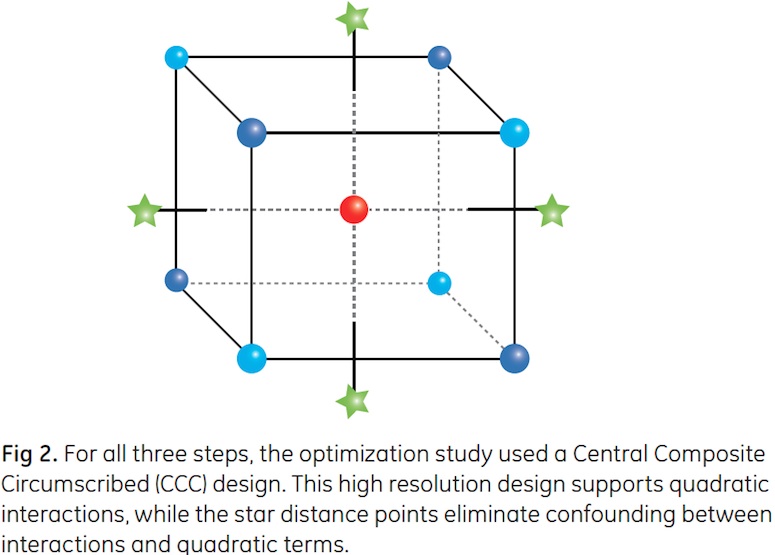
This general approach also supports QbD, where the plates give the characterized space and the DoE in columns provides both the design and the control space. The DoE for all steps is outlined in Figure 2.
Step 1 – Capture step with Capto L
For the capture step, Capto L was chosen and wide wash and elution conditions were evaluated in a 96-well format using PreDictor plates. Second, capacity studies were
performed in small columns with purified protein. Third, an elution pH study was performed to find the optimal elution pH. This might be especially important for some molecules that are sensitive to acidic pH values. DoE (Fig 2) was used to find the best conditions for the step.
For the dynamic binding capacity (DBC) studies Fab in an E. coli supernatant was first purified with Capto L. All runs were performed on pre-equilibrated columns on an ÄKTAexplorer™ 100 system equipped with a fraction collector. DBC for Capto L in the capture step was 21 mg/ml at 4 min residence time. The elution pH for this Fab was 3.2 when running a gradient from pH 6 to 2.5.
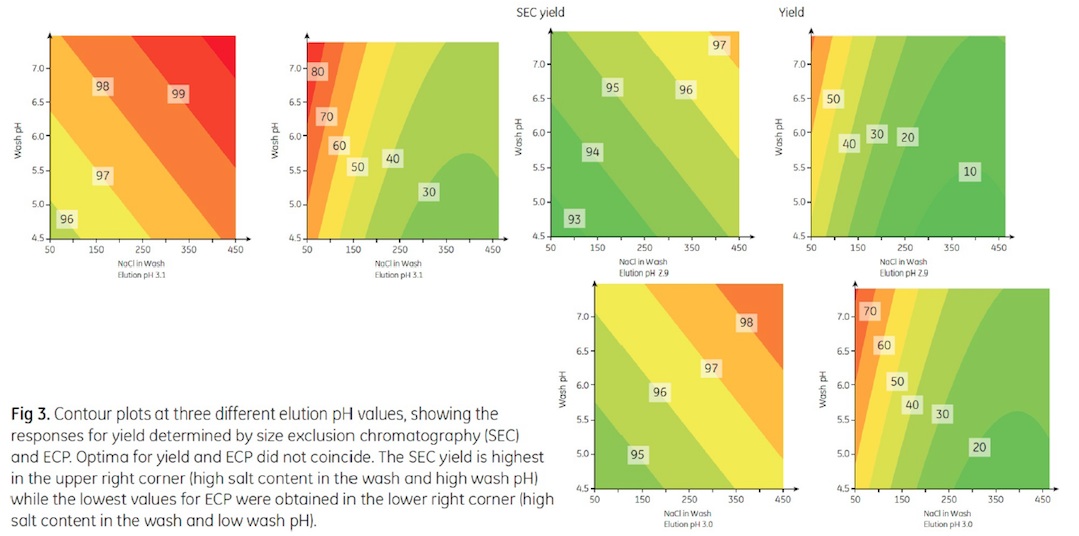
Following screening experiments, a three-factor DoE was performed. The studied factors were wash pH, NaCl concentration in the wash and elution pH. Some factors were kept constant. For instance, the load was 15 mg/ml, which corresponds to 70% of the DBC, a representative load for a production scenario. The residence time during the load was 4 min and the wash volume was 7 column volumes. The most important responses in this study were the E. coli protein (ECP*) content and the yield. Figure 3 shows the DoE results.
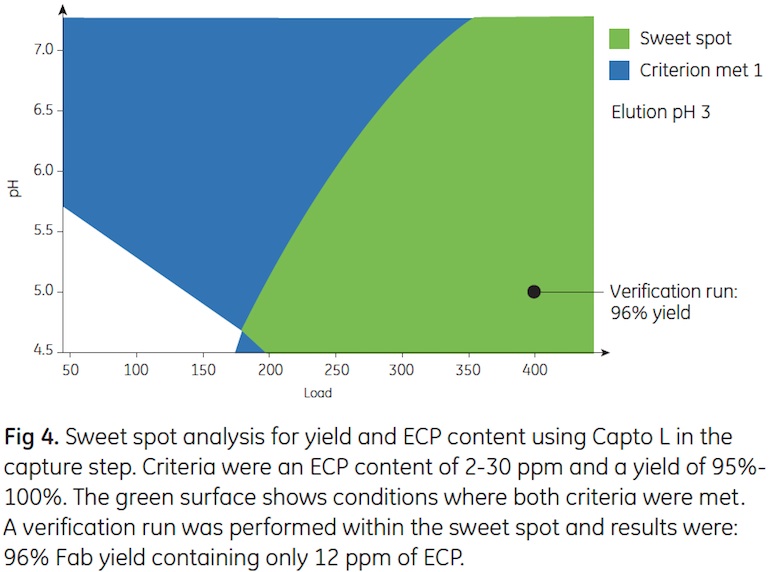
To combine the information achieved for ECP and yield and to find the overall optimum, sweet spot analysis was used (Fig 4). The green surface shows conditions where both criteria were met. A verification run was performed where the wash step contained an acetate buffer with a pH of 5 and 400 mM NaCl. The results were as expected: 96% Fab yield containing only 12 ppm of ECP.
Step 2 – Purification with Capto SP ImpRes
For the second purification step, the high resolution cation exchanger Capto SP ImpRes was chosen due to its ability to efficiently separate aggregates from monomers. DBC at 10% breakthrough was 80 mg/mL and 71 mg/mL at pH 4.0 and 5.5, respectively. The lowest DBC value was used to calculate the maximum load for the DoE study, where 70% of QB10 (i.e., approx. 50 mg/mL) was used as the center point. A DoE was used, where pH, gradient length (with NaCl) and load were studied. Some factors (e.g., residence time and wash length and final NaCl concentration) were kept constant.
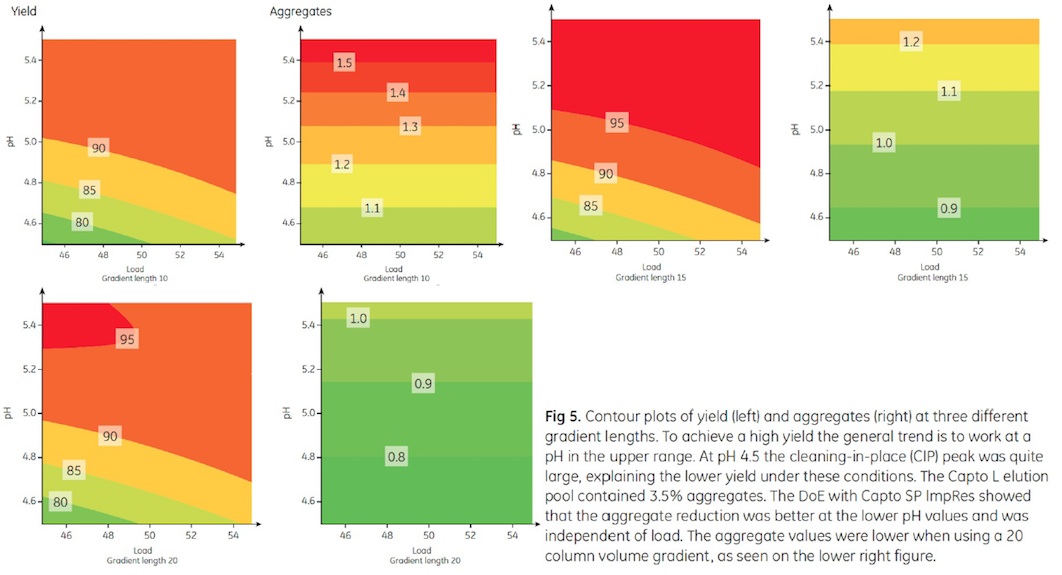
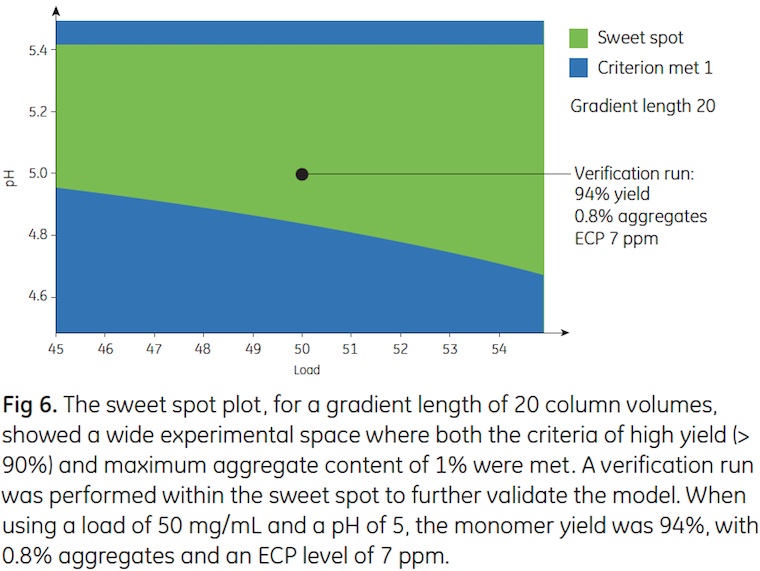
Aggregate content was determined by size exclusion chromatography using an ÄKTAexplorer 10 system and Tricorn™ 5/150 columns. The injection volume was 10 μL and the mobile phase (PBS) was run at a flow rate of 0.4 mL/min. UV detection was performed at 215 and 280 nm. The optima for yield and low aggregates did not coincide (Fig 5). The highest yield was in the upper region of the plot (pH ≥ 5.0) while the lowest aggregate content was in the lower region of the plot ( pH ≤ 5.0). To combine the information from these plots, a sweet spot analysis was performed and showed a wide experimental space where both the criteria (yield > 90% and aggregate content ≤ 1%) were met (Fig 6).
Step 3 – Polishing with Capto Q
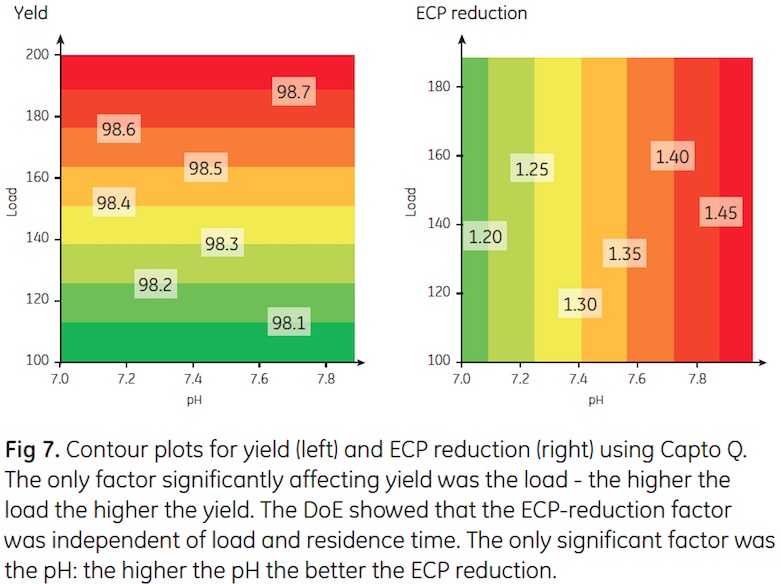
For the third step Capto Q, an anion exchanger, was used in the process to further reduce contaminant levels. Capto Q is an excellent choice for use in flowthrough mode for proteins with a high isoelectric point, such as this Fab. Since the isoelectric point is approximately 8.5, working at a pH of 8 or less will make the Fab pass in the flowthrough fraction. Figure 7 shows the contour plots for yield and ECP reduction. High loads generated higher yield, while pH and residence time had negligible impact. ECP reduction was increased with increasing pH, but residence time and load had no impact. For aggregate reduction (data not shown), no significant effects were detected. Using Capto Q in the third step provided high Fab yield in a broad range of parameters. ECP can be reduced 1.2 to 1.45 times in the pH interval 7.0 to 7.9
Process verification
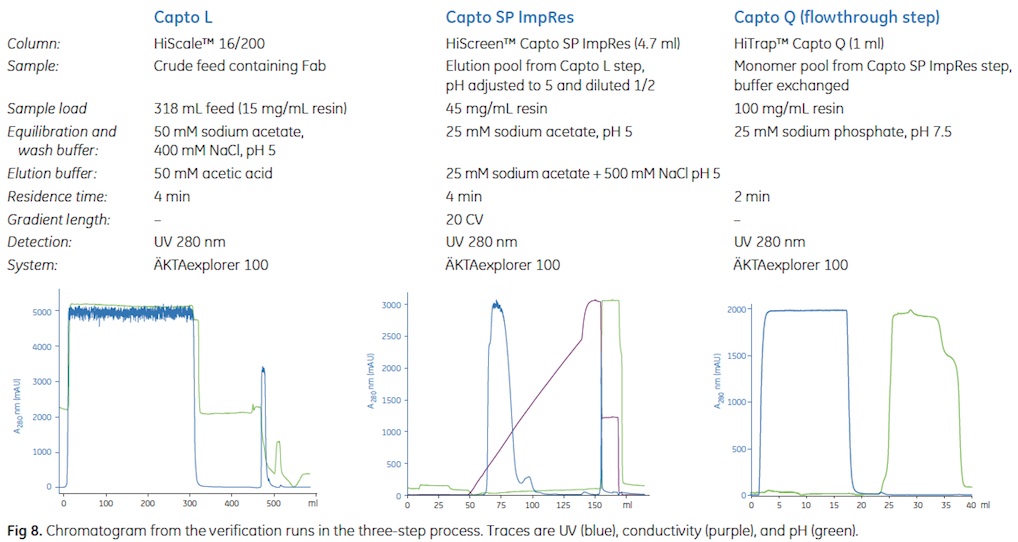
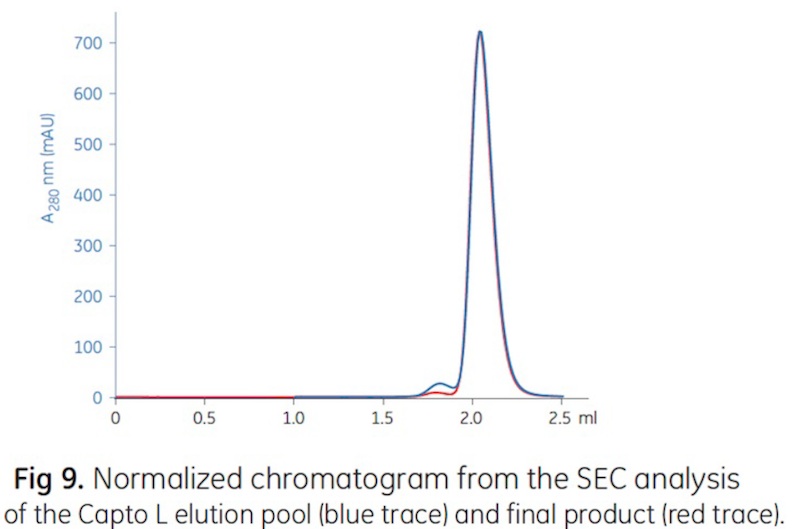
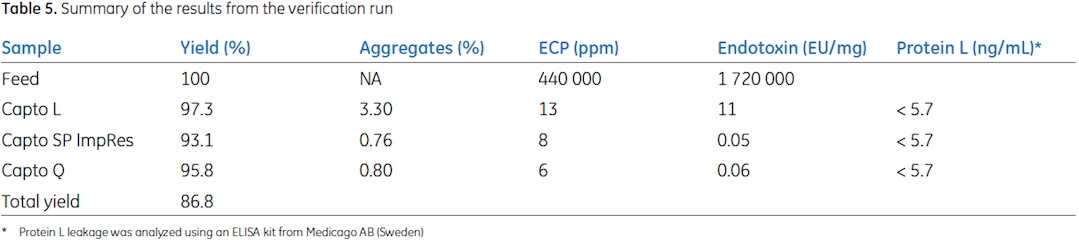
Having optimized the three steps and having a better knowledge of the effects of the most significant factors for each step, a process verification was performed. Results of the verification run for the three-step process are shown in Figures 8 and 9, and summarized in Table 2. The total process yield was 87% with 0.8% aggregate cont. ECP and endotoxin reductions both showed excellent results and protein L leakage was below the limit of quantification.
Summary
A three-step purification process for a Fab was successfully developed and verified. The step yield ranged between 93% and 97%, giving a total process yield of approximately 87%. Aggregates were reduced from 3.3% to approximately 0.8%. The ECP in the start sample was more than 400 000 ppm whereas the final sample contained only 6 ppm. The endotoxin content in the feed was 1.7 million endotoxin units/mg of protein and the final sample was below 0.1 units/mg. Protein L leakage was below the limit of quantification for all samples.
Market trends forecast an increased effort in developing therapeutics based on antibody fragments. GE Healthcare Life Sciences has developed Capto L, Capto ImpRes, and other Capto media to enable a platform approach for the purification of antibody fragments. Our results for a threestep Fab process using Capto media showed effectiveremoval of the main contaminants, low ligand leakage, and high yields over the entire process.
References
1 Data file: Capto L, GE Healthcare, 29-0100-08, Edition AB (2012).
For local office contact information, visit
www.gelifesciences.com/contact
GE Healthcare Bio-Sciences AB
Björkgatan 30
751 84 Uppsala
Sweden
GE, imagination at work, and GE monogram are trademarks of General
Electric Company.
ÄKTAexplorer, BioProcess, Capto, HiScale, HiScreen, HiTrap, MabSelect,
PreDictor, and Tricorn are trademarks of GE Healthcare companies.
Gyrolab is a Trademark of Gyrus Group.
KappaSelect and LambdaFabSelect incorporate BAC BV’s proprietary
ligand technology, which has been exclusively licensed to GE Healthcare
for affinity separation. Other uses of this product may require a
separate license from BAC BV, Huizerstraatweg 28, 1411 GP Naarden,
The Netherlands.
© 2012 General Electric Company – All rights reserved.
First published Oct. 2012.
All goods and services are sold subject to the terms and conditions of
sale of the company within GE Healthcare which supplies them. A copy
of these terms and conditions is available on request. Contact your local
GE Healthcare representative for the most current information.
GE Healthcare UK Limited
Amersham Place
Little Chalfont
Buckinghamshire, HP7 9NA
UK
GE Healthcare Europe, GmbH
Munzinger Strasse 5
D-79111 Freiburg
Germany
GE Healthcare Bio-Sciences Corp.
800 Centennial Avenue, P.O. Box 1327
Piscataway, NJ 08855-1327
USA
GE Healthcare Japan Corporation
Sanken Bldg., 3-25-1, Hyakunincho
Shinjuku-ku, Tokyo 169-0073
Japan
Related Topics and Keywords
96-well PreDictor™, capacity studies, chromatography media, design of experiments, DOE, elution studies, Fabs, GE Healthcare Life Science, manufacturing, platform approach, purification of antibody fragments, purification process, QbD, Quality by Design, Resins
Subscribe to our FREE newsletter and WEBINAR UPDATES
We will not sell or give your information to a third party. See our Privacy Policy