Dynamic binding capacity study on MabSelect SuRe™ LX for capturing high-titer monoclonal antibodies
Posted on October 30, 2014
The dynamic binding capacity (DBC) of MabSelect SuRe LX, an alkali-stabilized, protein A-derived affinity medium (resin) for capturing monoclonal antibodies (MAbs), was measured at different residence times and feed concentrations. DBC increased with increased residence time, while MAb concentration did not have any significant influence. MabSelect SuRe LX and MabSelect SuRe DBC were also compared for seven different MAb-containing feedstocks. At longer residence times, MabSelect SuRe LX displayed 20% to 46% higher DBC. The productivity of both was also analyzed. Results suggest that over its lifetime, MabSelect SuRe LX could purify up to 50% more antibody than MabSelect SuRe.
Introduction
Due to greater economic pressure on MAb production, the antibody titers in mammalian cell culture have increased dramatically over the last 20 years. Today, it is possible to see titers of 1 to 8 g/l, and feedstock expression levels as high as 15 g/l and greater have been reported. As a consequence, the demand for efficient chromatographic purification during manufacture has also increased. Unless this demand is met, purification operations risk limiting the throughput they can deliver, which will result in costly downstream processing bottlenecks.
MAb purification strategy
The large-scale purification of MAbs usually consists of two or three chromatographic steps. Protein A is the affinity chromatography ligand of choice for first-step capture as its high selectivity gives excellent purity (typically > 99%) plus high yields. Furthermore, protein A-based media are easy to use at both small and large scale. Protein A media therefore form the basis of a platform approach to MAb purification. Subsequent downstream processing can be performed using a variety of chromatography techniques and combinations, especially ion exchange, multimodal, and hydrophobic interaction chromatography.
Key role for MabSelect™ affinity media
Based on the protein A ligand, the MabSelect family of affinity chromatography media (MabSelect, MabSelect Xtra™ and MabSelect SuRe) has found wide acceptance among large-scale commercial manufacturers of biopharmaceutical MAbs. A recent addition is MabSelect SuRe LX, which comprises the same rigid highflow agarose matrix and alkali-stabilized, protein A-derived ligand as MabSelect SuRe. MabSelect SuRe LX thus enjoys the same performance attributes such as alkali and protease stability as well as generic elution. Compared with MabSelect SuRe, however, MabSelect SuRe LX offers more than a 20% increase in DBC at a slightly longer residence time. At 6 min residence time, for example, the medium’s capacity for human IgG is approximately 60 g/l. This study investigated the performance of MabSelect SuRe LX during MAb capture by measuring its DBC at different residence times and feed concentrations. MabSelect SuRe LX data were also compared with MabSelect SuRe. In addition, process economy parameters, specifically medium productivity and utilization during manufacturing, were also evaluated for both media.
Materials and methods
Samples
Frontal analysis was performed with both human IgG and clarified CHO cell culture supernatants containing various monoclonal antibodies.
Sample preparation
Clarified CHO cell culture supernatant was used either inits native state or after spiking with purified MAb to final concentrations of approximately 5 and 10 mg MAb/ml. The resulting MAb concentrations were analyzed by analytical chromatography using a 1 ml HiTrap™ MabSelect SuRe column.
Frontal analysis for determining dynamic binding capacity
MabSelect SuRe LX and MabSelect SuRe were packed in Tricorn™ 5/100 columns (bed height 10 cm, column volume 1.96 ml). Frontal analysis was performed with native and spiked feeds. Clarified CHO cell culture supernatant was applied to the column until approximately 10% breakthrough was achieved. This was followed by washing out unbound material with PBS buffer, elution with 0.1 M citrate, pH 3.0, and cleaning-in-place (CIP) with 0.1 M NaOH. Selected fractions during sample loading were analysed on a HiTrap MabSelect SuRe column using the buffers named above. Elution peaks were integrated and their areas in mAU × ml were compared to the peak area for the start material. The volume applied at 10% breakthrough (V10%) was defined from the fraction with 10% of the peak area in the start material.
For human IgG, V10% was determined from the UV curve at 280nm. Dynamic binding capacity at 10% breakthrough was calculated according to Equation 1.
DBC10% = (V10% – V0) C0/Vc [1]
where C0 = antibody concentration (mg/ml), Vc = geometric total volume (ml), and V0 = void volume (ml)
Process economy analyses
Productivity was measured (as g/l/h) while processing progressively higher titer feedstocks
Purification potential (Ppotential), which is used to show the manufacturing advantage of a medium, is defined as the mass of antibody that can be processed through the lifetime of a given quantity of media. It can be calculated from the product of the mass of antibody purified per batch through a certain volume of medium and the number of batches that can be processed through the same volume. This is outlined in Equation 2.
 Media utilization in manufacturing as well as related parameters were evaluated via purification potential analysis.
Results and discussion
Dynamic binding capacity vs residence time
Table 1 shows the DBC results for MabSelect SuRe LX for monoclonal IgG1 and human IgG at 10% breakthrough (DBC, 10% breakthrough) determined at residence times between 1 and 10 min (Fig 1).


Comparing corresponding data for both media (Fig 2) shows that their DBC is almost equivalent at short residence times (≤ 3 min), while MabSelect SuRe LX shows significantly higher DBC than MabSelect SuRe at longer residence times.

MAb concentration vs DBC and residence time
DBC, 10% breakthrough for MabSelect SuRe LX was determined with clarified CHO cell culture at three different MAb concentrations. Residence time was varied between 2.4 and 10 min. Results are shown in Table 2 and Figure 3. As expected, DBC increases with increased residence time, while the MAb concentration in the clarified CHO cell culture supernatant does not have any significant influence on DBC.


Dynamic capacity of different antibodies
DBC, 10% breakthrough for MabSelect SuRe LX and MabSelect SuRe was determined at 6 min residence time for seven different MAbs. Table 3 and Figure 4 show the results. As can be seen, DBC was 20% to 46% higher for MabSelect SuRe LX.


Productivity analyses
The gains in throughput and robustness that originate from its exceptional binding capacity, plus the proven mechanical stability of high-flow agarose, mean that MabSelect SuRe LX can capture MAbs at a broad range of flow velocities and sample loads. This translates into better processing productivity compared with MabSelect SuRe.
Figure 5 shows the results of measuring the productivity (gprotein /lmedium /h) of both media while processing progressively higher titer clarified CHO cell culture supernatant (1, 5, and 10 g/l). Highest gains were achieved when using MabSelect SuRe LX to process large amounts of antibody at loading velocities that ensure optimal use of the medium’s full binding capacity.

Media utilization in manufacturing
The high binding capacity of MabSelect SuRe LX allows large amounts of sample to be loaded onto the column. This can reduce processing times and/or allow current columns and hardware to be used instead of having to invest in new equipment when processes are scaled up. Incorporating the purification process into existing facilities should also be easier. In some cases, the volume of medium required to process a given mass of antibody can be reduced. In-house optimization calculations were conducted to identify performance gains using MabSelect SuRe LX compared with MabSelect SuRe within a high-throughput, large-scale MAb manufacturing environment. The aim was to process 10 000 l of high-titer fermentation broth within an 8 h working shift. Table 4 shows the results. The performance benefit of MabSelect SuRe LX is evident from an accompanying reduction in the quantity of medium and number of cycles required to purify the mass of antibody. Furthermore, these reductions also decrease the overall buffer consumption of the purification step.
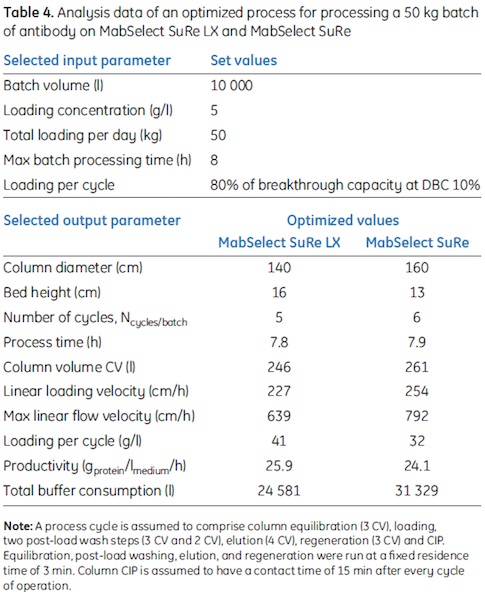
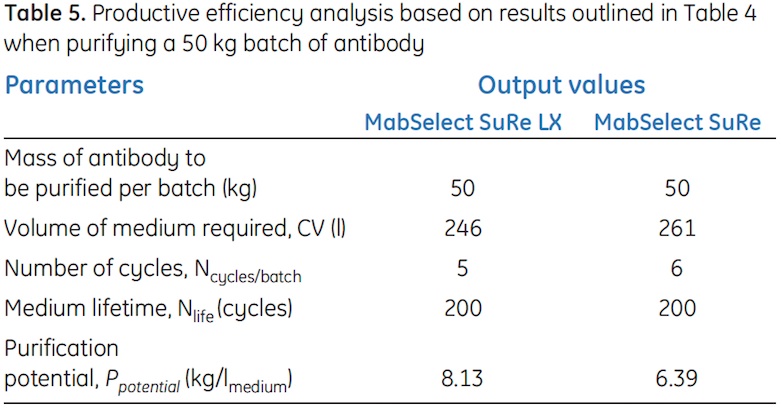
Table 5 shows the results of a purification potential analysis applied to the case described in Table 4. Assuming that the lifetime (Nlife ) of both media is equivalent, MabSelect SuRe LX will enable approximately 30% more mass of antibody to be purified over its lifetime than MabSelect SuRe (1). In many cases, MabSelect SuRe LX demonstrates an increased lifetime compared to MabSelect SuRe. Data from a lifetime performance study examining the effect of repeated cleaning-in-place (CIP) with 0.5 M NaOH on DBC show that MabSelect SuRe LX retains a greater percentage of its DBC than MabSelect SuRe over the same number of CIP cycles (1). A 20% longer lifetime, for example, plus 30% increased load, would result in > 50% more purified antibody per liter of medium over its lifetime.
Conclusions
As expected, DBC increases with increased residence time, while MAb concentration in the clarified CHO cell culture supernatant does not have any significant influence on DBC. At 6 min residence time, MabSelect SuRe LX gives ≥ 20% higher DBC compared to MabSelect SuRe, while the capacity is almost equivalent at residence times below 3 min. Adding the increase in lifetime of around 20%, MabSelect SuRe LX could purify up to 50% more antibody than MabSelect SuRe over its lifetime. Using MabSelect SuRe LX reduces processing times and allows the dimensions of columns and other equipment hardware to be reduced. As Table 4 shows, total buffer consumption can be decreased significantly, which should improve process economy by saving on preparation and handling costs. The overall result should be a muchimproved facility fit, that is, higher titer cultures can be processed using current equipment in existing facilities.

For local office contact information, visit
www.gelifesciences.com/contact
www.gelifesciences.com/mabselect
GE Healthcare Bio-Sciences AB
Björkgatan 30
751 84 Uppsala
Sweden
GE, imagination at work, and GE monogram are
trademarks of General Electric Company.
MabSelect, MabSelect Xtra, MabSelect SuRe, HiScreen,
HiTrap, and Tricorn are trademarks of GE Healthcare
companies.
All third party trademarks are the property of their
respective owners.
The Tricorn column and components are protected by
US design patents USD500856, USD506261, USD500555,
USD495060 and their equivalents in other countries.
© 2011 General Electric Company — All rights reserved.
First published Feb. 2011
All goods and services are sold subject to the terms and
conditions of sale of the company within GE Healthcare
which supplies them. A copy of these terms and conditions
is available on request. Contact your local GE Healthcare
representative for the most current information.
GE Healthcare UK Limited
Amersham Place
Little Chalfont
Buckinghamshire, HP7 9NA
UK
GE Healthcare Europe, GmbH
Munzinger Strasse 5
D-79111 Freiburg
Germany
GE Healthcare Bio-Sciences Corp.
800 Centennial Avenue, P.O. Box 1327
Piscataway, NJ 08855-1327
USA
GE Healthcare Japan Corporation
Sanken Bldg., 3-25-1, Hyakunincho
Shinjuku-ku, Tokyo 169-0073
Japan
Related Topics and Keywords
alkali-stabilized, binding capacity study, capturing high-titer monoclonal antibodies, DBC, dynamic binding capacity, GE Healthcare Life Sciences, mAb, MabSelect SuRe™ LX, monoclonal antibodies, protein A-derived affinity medium, resin
Subscribe to our FREE newsletter and WEBINAR UPDATES
We will not sell or give your information to a third party. See our Privacy Policy