

Development and benefits of a UPLC-RP method for the determination of extra- cellular synthetic Insulin-like growth factor 1 protein (ECS-IGF1) and its related compounds.
Posted on April 21, 2015
PURPOSE
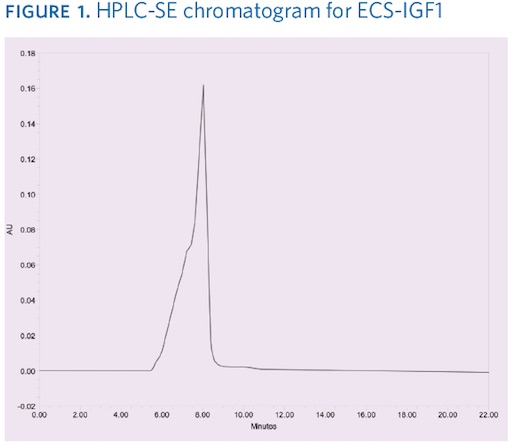
Extra Cellular Synthetic – Insulin-like Growth Factor 1 (ECS-IGF1), a polypetidic chain of 70 amino acids residues, is found in the extracellular matrix creating a physical structure that binds to the wound bed for cell attachment. This protein is critical for healing and vital for subsequent cell functions. Size Exclusion (SE) chromatography is commonly employed for separation of large proteins. However, with ECS-IGF1, the small proteins are aggregated in large molecules that do not allow appropriate identification of the protein and its related compounds (Figure 1). The aim of the study was to develop an efficient UPLC Reverse- Phase (RP) method allowing the determination and the quantification of the complex protein ECS-IGF1 and its related compounds.
METHODS
The chromatographic separation was achieved using UPLC BEH 300 Å C4 column (100×2.1 mm, 1.7 μm) at 60°C with reduced injection volume (10 μL). The gradient mobile phase consisted of water, acetonitrile and Trifluoroacetic acid (TFA) 0.1% with a flow rate of 0.15 ml/min. The effluent was monitored at 214 nm using photodiode array (PDA) detector.
Identification and structural characterization of each eluted compound was carried out using Time-Of-Flight Mass Spectrometry (TOF-MS) detector. The ECS peptide was separated from IGF1 by chemical reduction with DDT at high temperature.
RESULTS
The developed UPLC-RP method allows specific elution of 4 related compounds with good resolution in only 15 minutes; this is in contrast to conventional HPLC-SE which required 60 minutes to determine only the purity (coelution of all the related compounds) of the protein ECS- IGF1. The molecular structure of the different compounds has been determined by TOF-MS. Seven sites of cleavage with disulfites bounds and N-terminal extensions were characterized by the analysis of reduced and native forms.

CONCLUSIONS
Rapid, efficient and robust method was successfully developed for the identification and the quantification of ECS-IGF1 protein and its related compounds. The UPLC-RP method provides better separation than the HPLCSE method, while reducing the run time from 60 minutes to 15 minutes. UPLCMS analyses allowed the characterization of ECS-IGF1 with cleavage sites and N-terminal extensions. This UPLC method may be used both for the drug substance and for the drug product release. More generally, usage of UPLC-RP may be useful for similar small proteins that aggregate into large molecules.
ACKNOWLEDGMENT
We thank Kay Schmidt for her advices and Evan Galvanek for his technical support. This work was supported by Catalent Pharma Solutions.
CONCLUSIONS
© 2014 Catalent Pharma Solutions. All rights reserved.
ACKNOWLEDGMENT
Rapid, efficient and robust method
was successfully developed for the
identification and the quantification of
ECS-IGF1 protein and its related
compounds. The UPLC-RP method
provides better separation than the HPLCSE
method, while reducing the run time
from 60 minutes to 15 minutes. UPLCMS
analyses allowed the characterization
of ECS-IGF1 with cleavage sites and
N-terminal extensions. This UPLC method
may be used both for the drug substance
and for the drug product release. More
generally, usage of UPLC-RP may be useful
for similar small proteins that aggregate
into large molecules.
We thank Kay Schmidt for her advices and
Evan Galvanek for his technical support.
This work was supported by Catalent
Pharma Solutions.
Related Topics and Keywords
Catalent Pharma Solutions, ECS-IGF1, extra cellular synthetic Insulin-like growth factor 1 protein, polypetidic chain, Reverse Phase, RP, SE, Size Exclusion, UPLC-RP
Subscribe to our FREE newsletter and WEBINAR UPDATES
We will not sell or give your information to a third party. See our Privacy Policy