


Over-the-counter Product Analysis Using Raman Spectroscopy
Posted on October 14, 2014
Over-the-counter (OTC) medications, similar to pharmaceutical drugs, are formulated with one or more active pharmaceutical ingredients (API) in the presence of a complex matrix of excipients such as binders, disintegrant compounds, preservatives, flavors, and or colors. Many API ingredients have chemical structures consisting of aromatic and symmetric bonds that make them easily detectable by Raman, even in the presence of complex matrices. Raman provides a high degree of chemical specificity and can be used to confirm the chemical identity of materials.
OTC medications are highly regulated by global FDA and other national Boards of Health and subject to current Good Manufacturing Practice (cGMP) requirements just as prescription drug products. These medications are manufactured under Compendial guidance such as the United States Pharmacopeia (USP) in the US or the European Pharmacopoeia (Ph. Eur.) in the European Union. Most OTC products in the US are considered “Monograph” products. As such, they are standardized according to a USP Monograph, a document that specifies the types of ingredients and API dosage levels that can be formulated in specific types of products. A monograph will normally require use of a stability indicating analytical method to characterize the efficacy of a drug product, but it will also require an identification test in order to release the product from manufacturing. Release testing for Monograph products is dependent on the specific type of product, syrups, tablets, etc. as well as the formulated actives. Raman’s ease of use, repeatability, chemical selectivity makes it a good method for routine identification of manufactured OTC products.
Experiment
All the OTC products analyzed were acquired at a retail pharmacy. A dual band Rigaku Raman Technologies XantusTM-2 (785 / 1064nm) spectrometer was used to collect Raman data at both wavelengths. Tablet data was measured using the external nose-cone accessory. Laser power for Raman measurements varied between 300 to 400 mW with integration times between 1 to 2 seconds. White Excedrin® Extra Strength Tablets and green Extra Strength Headache Relief Gelcaps were measured as purchased over-the-counter. Zantac® and the equivalent store brand product tablet cores were both measured as well as the coated products.
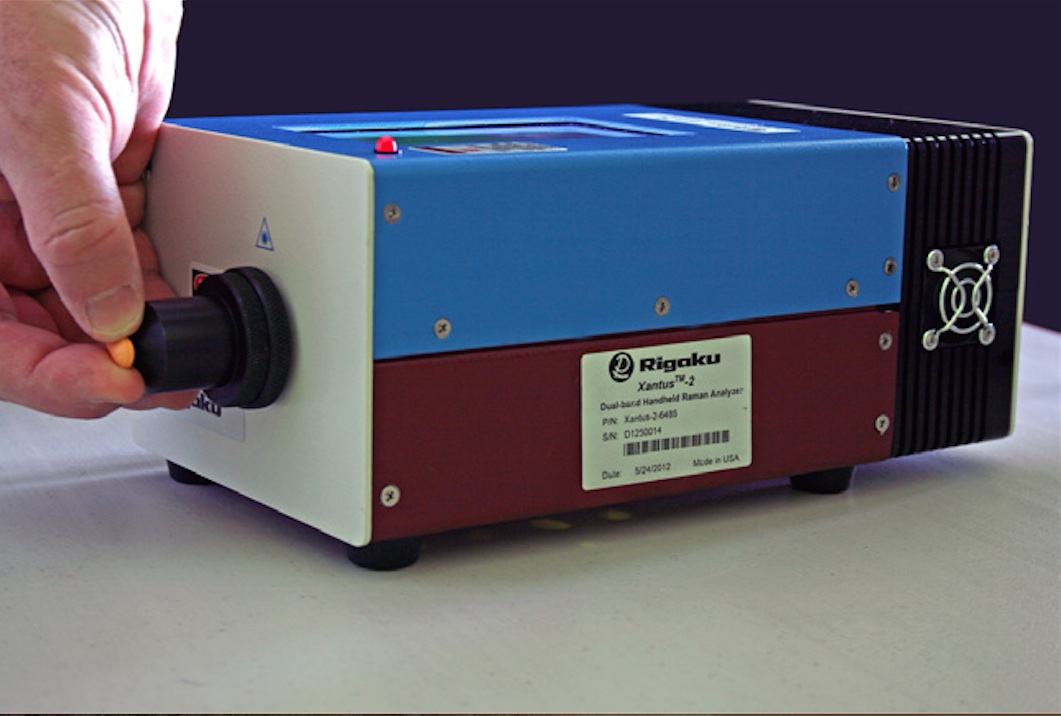
Rigaku’s XantusTM -2 785/1064 DualWavelength Spectrometer.
Results
White tablets such as Excedrin® Extra Strength (Novartis Consumer Healthcare) can easily be measured using either 785 nm or 1064 nm Raman, with the primary API Raman peaks associated with aspirin and acetaminophen, easily detectable, Figure 1. However, the Rapid Release Gelcap (Store Brand) version of this formulation, with a dark green gelatin capsule, is only measurable using 1064 nm based excitation laser. Identifiable Raman peaks from this sample was obscured by fluorescence with 785 nm excitation, Figure 2. Raman is extremely sensitive to small changes in crystal structure, pharmaceutical applications include polymorphism, hydrates, solvates, and API-salts as well. Raman spectra can easily distinguish polymorphic forms of Ranitidine HCl, the API in Zantac® (Boehringer Ingelheim) against the generic, store brand formulation with a different polymorphic structure. (1) Both 785 nm and 1064 nm excitation could be used to identify the Ranitidine HCl polymorphs from tablet cores, where the coating had been mechanically removed, Figure 3.
Figure 1. Comparison of 785 nm and 1064 nm Raman spectra for a coated, white analgesics tablet. Raman bands corresponding to the primary API compounds are labeled, APAP = acetaminophen and APS = aspirin.
Figure 2. Comparison of 785 nm and 1064 nm Raman spectra for a dark green analgesics gelatin capsule. Raman bands corresponding to the primary API compounds are labeled, APAP = acetaminophen and APS = aspirin. No Raman bands observable using 785 nm excitation due to fluorescence interference.

Figure 3. Polymorphic forms of Ranitidine HCl measured from tablet cores of brand name and comparative generic product using 785 nm Raman.
Summary
Today, modern spectrometers with their decreased size and multiple excitation wavelengths, have made Raman an important and flexible analytical tool for verifying OTC pharmaceuticals. Powerful portable spectrometers, like the Rigaku Raman Technologies XantusTM-2 and FirstGuardTM, can allow for OTC products to be validated at more points throughout the manufacturing process and distribution chain. OTC products are manufactured with a variety of colors and flavors and the availability of multiple Raman excitation wavelengths allows for a wider range of samples to be analyzed, including some that traditionally could not be measured due to fluorescence
interference.
References: Taylor LS, Langkilde, FW. 2000. Evaluationof Solid-State Forms Present in Tablets by Raman Spectroscopy. J Pharm Sci. 89:1342–1353.
Corporate Headquarters
Boston, MA USA; Tokyo, Japan
Manufacturing
Tucson, AZ USA
Corporate Sales Offices
Baltimore, MD USA; Hong Kong, China; Helsinki, Finland; Munich, Germany
Local distributors worldwide
Rigaku Raman Technologies, Inc.
Toll Free: +1 855.785.1064
Direct: +1 781.328.1024
Email: info@rigakuraman.com
Related Topics and Keywords
active pharmaceutical ingredients, API, OTC, Over-the-counter, product analysis, raman spectrometer, Rigaku
Subscribe to our FREE newsletter and WEBINAR UPDATES
We will not sell or give your information to a third party. See our Privacy Policy