
Correlation of Wedge Temperature and Gelatin Molecular Weight of Gel Mass Aged from 0 to 105 Hours during Encapsulation
Posted on April 21, 2015
ABSTRACT
Objective
The purpose of this study was to demonstrate that as the gel mass is aged from 0 to 105 hours by heating, the molecular weight (M.W.) of the gel mass decreases and as the gel ages, the wedge temperature (the temperature required to obtain acceptable seals at the encapsulation machine) can be decreased while maintaining the required seal thickness.
Materials
• Captex 355 purchased from ABITEC.
• 150 bloom Lime Processed Gelatin purchased from Rousselot.
• Glycerin purchased from Proctor and Gamble. Equipment
• Catalent 7th generation Encapsulation Machine.
• 9.5 oblong Narrow Wall Dies
• HPLC Set-Up for Size Exclusion Chromatography
Background
Many of the softgel manufacturers use a 150 bloom lime processed gel for the manufacture of their softgels. The 150 bloom lime processed gel whether bovine bone, bovine hide, or a blend of bovine hide and bone tends to contain a large amount of beta (~180,000 M.W.) and gamma chains (~300,000 M.W.). The beta chains consist of two alpha chains (~90,000 M.W.) covalently bonded together. The gamma chains consist of three alpha chains covalently bonded together. The double and triple bonded chains result in more intra ionic bonding and less inter ionic bonding between the chains in the gel mass and thus a lower bloom and higher viscosity. Because of the greater M.W., viscosity, and viscoelastic properties of the l50 bloom lime processed gelatin, depending on the source of the gelatin, it may be more difficult to form seals with the gel ribbon without using a high wedge temperature during the manufacture of the softgels which can cause misshapes, leakers, etc. By aging thegelatin, the M.W. is reduced and this can result in theformation of seals at lower wedge temperatures. Todemonstrate this, a standard L2ARB gel mass wasprepared and aged for approximately 5 days (105 hours)in a jacketed gel receiver at approximately 60 °C.Each day for five days, softgels were manufactured ona 7th generation encapsulation machine encapsulatinga medium chain triglyceride placebo fill. All machine parameters (drum temperature, spreader box temperature, machine speed, etc.) remained constant.
The only machine adjustment that could be made was the wedge temperature. The wedge temperature was adjusted as required to obtain acceptable seals. Each day, samples of the softgels were obtained and the M.W. determined for each sample. A comparison was made from each day’s encapsulation run between the wedge temperature, M.W., and seals as described in Table 1.
RESULTS
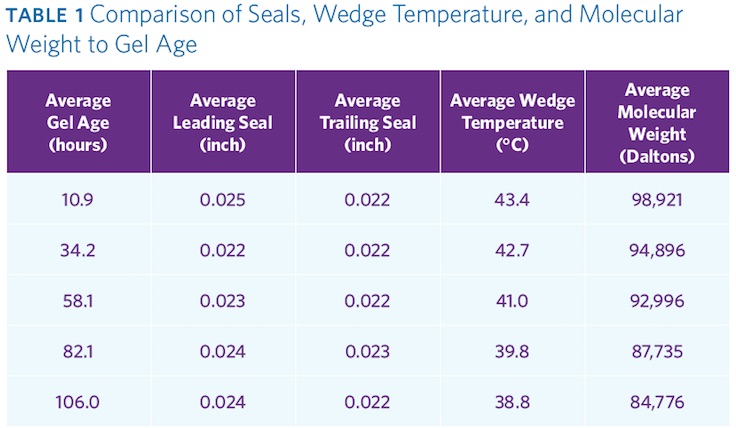
On the first day, softgels were manufactured approximately 11 hours after the gel mass was removed from the gel melter and placed into the jacketed receivers at 60 °C. The seals were much higher than expected and the wedge temperature was much lower. However, the molecular weight of this particular gel was only 98,921 Daltons. For other gels of this type, the molecular weight can range from 110,000 to 120,000 Daltons. As expected, the molecular weight decreased each day. As the molecular weight decreased, the operator was able
Based on the slope of the line, the wedge temperature was decreased approximately 0.05 °C per hour of gel aging. This provides some indication of the importance of gel aging to wedge temperature. The reason that the wedge temperature can be reduced is due to the decrease in the molecular weight of the gelatin. The decrease in the molecular weight results from the hydrolysis of the gelatin chains. The covalent bonds between the beta and gamma chains are broken forming alpha chains or either split chains composed of broken alpha chains bonded together or the alpha chains are split forming smaller peptide chains. The hydrolysis of the gel mass results in a reduction in the molecular weight and viscoelastic properties of the gelatin. This makes it easier to form the seals between the two ribbons at the encapsulation machine. The change in the average molecular weight as the gel ages is described in Figure 2.
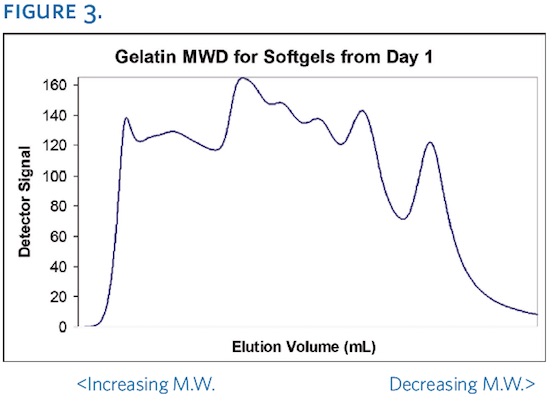
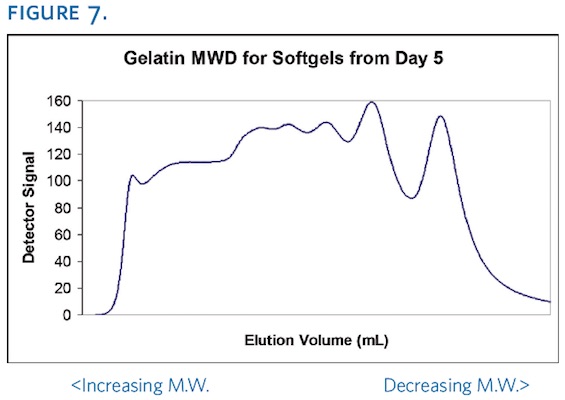
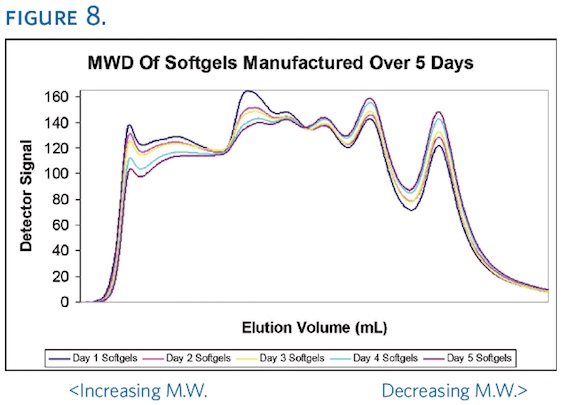
Based on the slope of the line, the average molecular weight of the gelatin decreases at a rate of 148.88 Daltons per hour of gel aging. This is true for this gelatin but if the manufacturer of the gelatin or the type of gelatin changes this rate may change. More studies will be required to determine the relationship between the rate of break down of the gelatin to the gel supplier and type of gelatin for the same gel formula. The molecular weight chromatograms are presented in Figures 3 (Day 1), 4 (Day 2), 5 (Day 3), 6 (Day 4), 7 (Day 5), and 8 (Overlay of all 5 days). The higher molecular weights are on the left of the chromatograms and the lower molecular weights are on the right of the chromatograms. The front peak to the far left consist of molecules 300,000 Daltons or greater. The last peak, to the far right, consist of peptides of approximately 15,000 to 20,000 Daltons. As the gel ages, the front peak decreases as the larger molecular weight molecules are broken down and the middle peaks and last peak increases with the formation of smaller chains and peptides. Figures 3 through 7 show the progression of the decrease of the molecular weight as the gel ages and is broken down to the smaller chains and peptides. The last chromatogram, Figure 8, provides an overlay of all the chromatograms which displays the decrease of the front peaks with an increase in the end peaks as the gelatin is hydrolyzed. As the molecular weight of the gel decreases, the melting point of the gel decreases and the viscoelasticity of the gelatin decreases. This allows the gel to melt easier at the wedge at a lower temperature, the gel is more elastic, and it is easier for the gel to stretch as the fill solution is injected into the softgel. This results in better seals at a lower wedge temperature.
CONCLUSIONS
The purpose of this study was to determine if there was a correlation between the wedge temperature required to make softgels and the molecular weight of the gelatin as the gel is aged in a jacketed gel receiver at 60 °C over a period of approximately 105 hours (5 days). Table 2 compares the Average Gel Age to the Average Molecular Weight and Average Wedge Temperature.

Comparing the data in Table 2, there is definitely a correlation between the molecular weight of the gelatin and the wedge temperature. As the molecular weight of the gelatin decreases, the wedge temperature can be decreased. As the molecular weight of the gel decreases, the melting point of the gel decreases and the viscoelasticity of the gelatin decreases. This allows the gel to melt easier at the wedge at a lower temperature, the gel is more elastic, and it is easier for the gel to stretch as the fill solution is injected into the softgel. This results in better seals at a lower wedge temperature.Thus, based on the results of this study, there is a correlation between the hydrolysis of the gelatin with time due to heating which results in the ability to make softgels at a lower wedge temperature.
Related Topics and Keywords
encapsulation machine, Gel Mass, Gelatin Molecular Weight, M.W, molecular weight, Temperature
Subscribe to our FREE newsletter and WEBINAR UPDATES
We will not sell or give your information to a third party. See our Privacy Policy