




Lilly announces new modified titration of Donanemab demonstrated reduction of ARIA-E in phase 3b study
Posted on November 4, 2024
Eli Lilly announces their new positive results from the TRAILBLAZER-ALZ 6 Phase 3b study, showing a reduction in amyloid-related imaging abnormalities with edema/effusion at the 24-week primary endpoint for people receiving a slightly modified titration of donanemab in adults with early symptomatic Alzheimer’s disease. Donanemab is approved under the brand name Kisunla in the United States, Japan, Great Britain and other countries.
Note that: TRAILBLAZER-ALZ 6 is a multicenter, randomized, double-blind, Phase 3b study to investigate the impact of different dosing regimens of donanemab on the rates of ARIA-E and amyloid clearance in adults with early symptomatic AD, which includes mild cognitive impairment and the mild dementia stage of disease.
“Lilly is committed to continuing research to optimize therapy for patients with Alzheimer’s disease. We are confident in the benefits of Kisunla’s currently approved dosing regimen and are excited that these results reveal a path to potentially improving on Kisunla’s profile by reducing the risk of ARIA-E,” said Mark Mintun, M.D., group vice president Neuroscience Research & Development, Eli Lilly and Company, and president of Avid Radiopharmaceuticals. “The modified titration could offer continued convenience of once-monthly dosing and limited duration treatment while also reducing ARIA-E and maintaining similar amyloid plaque removal.”
The study included four treatment arms. One arm was the once-monthly standard dosing regimen used in the Phase 3 TRAILBLAZER-ALZ 2 trial. The other three arms used alternative dosing regimens with the same total drug administered. The results at 24 weeks showed the once-monthly modified titration described below met the predefined study success criteria and demonstrated the greatest reduction of ARIA-E compared to the other dosing arms.
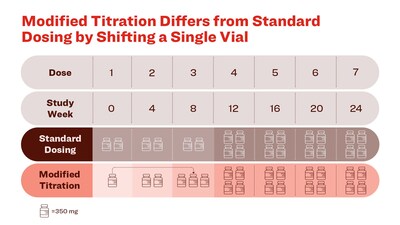
- Patients on the standard dosing regimen received two vials (700 mg) of donanemab for the first three infusions, then four vials (1400 mg) thereafter.
- Patients on the modified titration received 1 vial (350 mg) for the first infusion, two vials (700 mg) for the second infusion, three vials (1,050 mg) for the third infusion, and four vials (1400 mg) per infusion thereafter.
Patients on the modified titration of donanemab saw reduction of amyloid plaque and P-tau217 comparable to patients receiving the standard dosing regimen. As observed using amyloid PET at 24 weeks, amyloid plaque levels in patients on the modified titration of donanemab in TRAILBLAZER-ALZ 6 were reduced on average 67% from baseline compared to 69% for patients on the standard dosing regimen. In addition, the pathological relevance of beta-amyloid plaques in the development of Alzheimer’s disease and the importance of removing plaques to slow disease progression has been well-established: both the Phase 3 TRAILBLAZER-ALZ 2 study and the Phase 2 TRAILBLAZER-ALZ study demonstrated that the removal of amyloid plaque from the brain can lead to statistically significant slowing of cognitive and functional decline in patients with early symptomatic Alzheimer’s disease.
This study is ongoing with data investigating the potential reduction of ARIA-E in adults with early symptomatic AD at week 52 expected early next year. Aside from the improvement in ARIA-E rates, safety profiles were comparable across arms, and no new safety signals were identified. The frequency of infusion-related reactions in the modified titration arm was similar to the standard dosing arm. One participant in the modified titration arm with an ongoing ARIA-E presented stroke-like symptoms, and after receiving tissue-type plasminogen activator treatment, subsequently died due to cerebral intraparenchymal hemorrhage. As noted in the FDA labeling for this class of medicines, caution should be exercised when considering the administration of agents such as thrombolytics to patients already being treated with amyloid targeting therapies.
Related Topics and Keywords
Alzheimer's disease, ARIA-E, donanemab, lilly pharma, phase 3b study
Subscribe to our FREE newsletter and WEBINAR UPDATES
We will not sell or give your information to a third party. See our Privacy Policy















