Development and evaluation of a research screening assay to elucidate potential endogenous binding partners of Captisol®
Posted on March 4, 2016
By: Randall Logan1, Sirantha Perera1, J.D. Pipkin2 and Jeffrey P. Krise1,*
Captisol
1Department of Pharmaceutical Chemistry, University of Kansas, Lawrence, Kansas, USA
2Ligand Pharmaceuticals Inc. Lawrence, Kansas, USA

PURPOSE
Captisol® is a sulfonated b-cyclodextrin that forms inclusion complexes with drugs and is utilized as a drug-solubilizing excipient in a variety commercial drug formulations. Traditional approaches for assessing the binding affinity of drugs with Captisol® are relatively low-throughput consume relatively large amounts of drug and cyclodextrin. Such approaches typically involve titrating cyclodextrin and measuring the effect of binding on drug properties (i.e. solubility, pKa, NMR chemical shift, etc.)The purpose of this work was to develop and evaluate an alternative method that could be used to assess the strength Captisol® interaction with putative binding substrates. Ultimately, this assay will be used to screen fractionated biological tissue samples in an effort to identify endogenous binding partners, which may provide information that will help reveal the potential biological effects of cyclodextrins.

METHODS
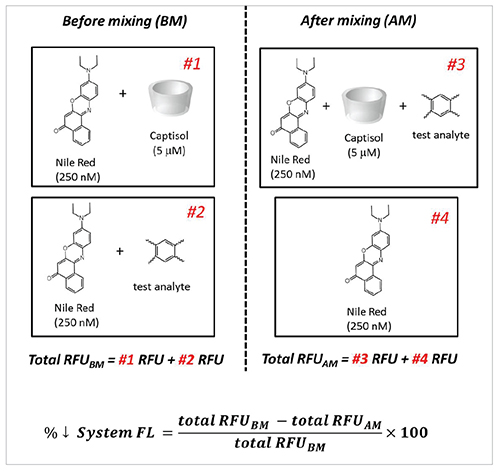
In order to assess the binding of Captisol with endogenous analytes, a competitive displacement-type assay employing environmentally sensitive fluorophore Nile red was designed. Nile red exhibts relatively strong fluorescence when complexed with Captisol and this fluorescence is substantially reduced when another molecule displaces it. Each experimental assessment of binding requires a total of 4 fluorescence readings. Two readings are taken to record the total system fluorescence before the unknown analyte is directly exposed to Captisol (total RFUBM) and two more are taken after the all components of the system have been mixed (total RFUAM). The percent decrease in system fluorescence that results from Nile red competitive displacement is mathematically derived according to the equation shown. All measurements are taken in pure H2O after 24 hour incubation period.
RESULTS

The fluorescence of Nile red increases as the concentration of Captisol increases. Nile red concentration was held constant at 250 nM.
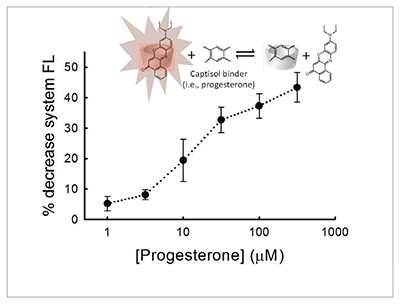
The addition of known Captisol binders can competitively displace Nile red and cause a reduction in the system fluorescence in a concentration-dependent manner.
Assessment of the assay
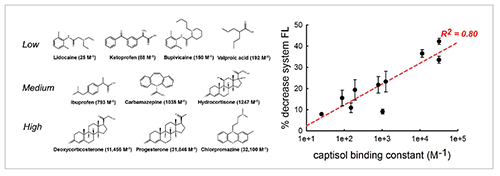
Using a series of 10 molecules with previously reported1 low, medium and high Captisol association constants the performance of the Nile red assay was evaluated. The plot reports the % decrease in system FL for each of the 10 molecules using the Nile red competitive binding assay (Y-axis) against the previously reported Captisol binding constant from the literature (X-axis). The good correlation between these two assays (R2 = 0.8) suggests that the Nile red assay can be utilized to predict Captisol binding affinities.
Screening for endogenous Captisol binders
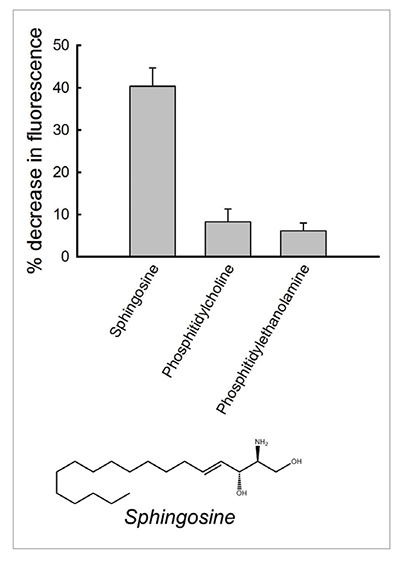
Initial screening of endogenous molecules revealed that Captisol appears to bind the sphingoid base sphingosine with high affinity, comparable to progesterone. The binding affinity with other membrane phospholipids appeared to be significantly less in magnitude suggesting some specificity for sphingosine.
The concentration of each lipid was 10 μM.
CONCLUSION / FUTURE DIRECTION
• The Nile red-based competitive binding assay appears to reliably predict Captisol binding affinity.
• Preliminary screens with this assay reveal that sphingosine is a potentially strong binder of Captisol, relative to other molecules screened.
• The assay is amenable to a high throughput screening format to potentially allow for the identification of putative Captisol binding partners from large arrays of unknowns (i.e., fractionated tissue extracts).
REFERENCES / FUNDING
1. Merzlikine, A.; Abramov, Y.A.; Kowsz, S.J.; Thomas, V. H.; Mano, T. International Journal of Pharmaceutics 2011,418,207-216.
Acknowledgements This work was performed in collaboration with the Department of Pharmaceutical Chemistry at The University of Kansas. The authors: Randall Logan, Sirantha Perera, and Jeffrey P. Krise*(University of Kansas, Lawrence, Kansas, USA) and J.D. Pipkin (Ligand Pharmaceuticals Inc. Lawrence, Kansas, USA); would like to thank Ligand Pharmaceuticals Incorporated for funding. This paper, for the most part, was originally presented at 2013 Annual Meeting American Association of Pharmaceutical Scientists in San Antonio, Texas – T30232.
To Learn more go to www.captisol.com/
Subscribe to our FREE newsletter and WEBINAR UPDATES
We will not sell or give your information to a third party. See our Privacy Policy